Twenty-Plus Tools, Replaced by One Platform
Construction runs on a dozen disciplines that all need the same project data and must never see each other's commercials. We built the platform that holds all of it — programme, commercial, procurement, documents, safety, logistics — with every stakeholder walled off from the rest.
Industry
Construction / PropTech
Solution
Project Lifecycle Platform
Engagement
~7.5 Months, Ongoing
Services
AI & Enterprise Development
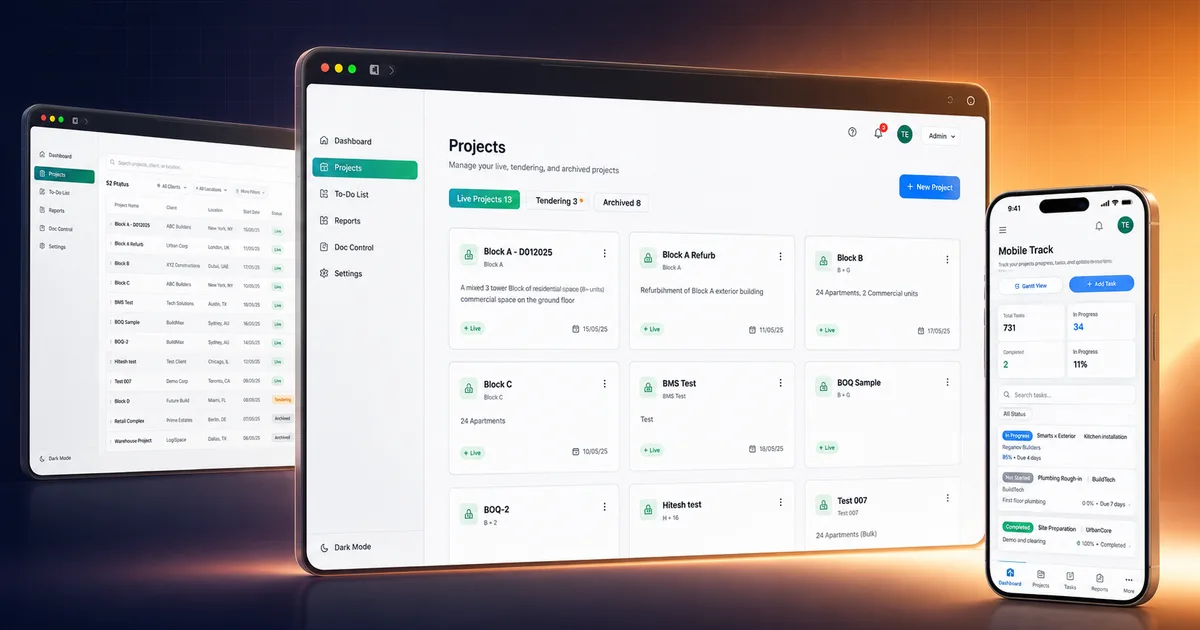
One Project, Ten Kinds of Stakeholder
A construction project has a main contractor, subcontractors, suppliers, a client, consultants and manufacturers — and every one of them needs a slice of the same project, while seeing none of the others' commercial position.
That is the hard part. Not the Gantt chart, not the document register: the fact that the quantity surveyor, the site manager, the supplier bidding on a tender and the client paying for it all need the same underlying data, filtered by exactly what they are entitled to. Before this, that meant a different tool per discipline and a lot of emailing spreadsheets around.
The Problems We Set Out to Solve
The intake marks the client's before-state as needing human input, and labels these as inferable technical challenges. We present them as the engineering problems the architecture was designed against — which is what they are.
Fragmented workflows across many disciplines needing one system
Multi-stakeholder collaboration without leaking commercial data between parties
Data trapped in PDFs and drawings — safety documents, bills of quantities, tenders
Access rules that differ by role, by project, by module and by plan
One Platform, Many Walls
The architecture is dominated by one requirement: every stakeholder sees exactly their slice and nothing else — enforced in the database, not in the interface.
Authorisation in Four Layers
Global roles, project roles, custom per-module permissions and plan-based gating, enforced by Postgres row-level security with permissive account policies and restrictive role policies — so a stakeholder portal cannot reach past its wall.
AI That Reads the Paperwork
Serverless functions extract structured data from documents, bills of quantities and safety method statements, and analyse tenders, quotations and the critical path — the parts of the job that were previously read by hand.
The Procurement Lifecycle, Automated
Tenders, requests for quotation, quotations and awards through to purchase orders, with email, SMS and in-app notifications fanning out at each step.
Slot-Based Logistics
Deliveries booked into slots by suppliers themselves, with docket capture — instead of a site manager fielding calls about who is arriving when.
What the Platform Does
Dashboard
Configurable widgets with AI insights, gated by the viewer's role and their plan.
Programme & Gantt
Multiple scheduling engines for programme, baselines and critical-path analysis, with virtualised drag-and-drop across large projects.
Commercial
Bills of quantities with comparison reports, valuations, cost-value reconciliation, cost codes and invoicing.
Procurement
Tenders, requests for quotation, quotations, awards, a supplier portal and the full purchase-order lifecycle.
Document Control
Registers, folders, drawings and design packages, with AI extraction and approval workflows over the top.
Health & Safety
Method statements with AI extraction and approval, permits, inductions, daily briefings with signatures, and incident reports.
QA & Snagging
Quality inspections and defect tracking through to close-out.
Logistics
Slot-based delivery booking, supplier bookings, and AI docket capture on arrival.
Fleet, HR & Inventory
The operational modules around the build, with ERP-style analytics over them.
Reports
A report builder, financial consolidation, and shareable reports for stakeholders outside the platform.
Aftercare Portal
Post-completion defect handling with AI search across the project's history.
Stakeholder Portals
Separate external portals for suppliers, subcontractors, clients and consultants — each scoped to what they are entitled to.
Mobile & Site
Mobile tracking, site clock-in, QR check-in, an induction kiosk, permit verification and method statements on a phone.
Admin & Billing
Subscription checkout and billing portal, plan selection, demo mode, and a "login as" impersonation tool for support.
Serverless, Row-Level Secure, AI-Assisted
Frontend
Backend
Data & Access
AI & Integrations
How It Was Built
- 1
One Integrated Platform
Twenty-plus modules in a single application rather than a suite of tools that need to be reconciled.
- 2
Authorisation First
The four-layer permission model — global role, project role, per-module permission and plan — built before the modules that depend on it.
- 3
AI-Assisted Workflows
Serverless functions for document, bill-of-quantities and safety-statement extraction, plus tender, quotation and critical-path analysis.
- 4
Procurement & Logistics
The tender-to-award-to-purchase-order flow and slot-based delivery booking, with notifications fanning out across email, SMS and in-app.
- 5
Stakeholder Portals
Separate scoped surfaces for suppliers, subcontractors, clients and consultants, each seeing only their own slice.
What Was Delivered
20+
Modules in One Platform
94
Application Routes
~221
Edge Functions
749
DB Migrations
Twenty-plus separate tools collapse into one platform working off one set of project data.
Every stakeholder — supplier, subcontractor, client, consultant — sees exactly their slice, enforced in the database rather than the interface.
Safety statements, bills of quantities and tender documents are read by AI instead of by hand.
Deliveries are booked into slots by the suppliers themselves, with the docket captured on arrival.
Frequently Asked Questions
Yes — this build collapsed twenty-plus modules into a single application rather than a suite of tools that need to be reconciled. Programme, commercial, procurement, document control, health and safety, QA, logistics and more all work off one set of project data, so the quantity surveyor, the site manager and the client are all looking at the same underlying information filtered to what they are entitled to.
Services Behind This Build
Explore Other Case Studies
Running a project across a dozen disconnected tools?
We build platforms where every discipline works off the same data — and no stakeholder can see past their own wall.
Talk to a Delivery Expert